Tuesday, April 23, 2013

In the Long Run (and lots of walking)


The Zion 100 did not go as planned, but it was a fantastic day nonetheless.  Instead of running alone, I ran with Marshall for Miles 5 through 55, until he and his pacer, Michael, took off.  Marshall ran a personal best of 23:31.  My pacers, Dave and Kim, kept me company from Mile 52 to the finish, so I had someone running with me the entire way.  And, of course, I talked to my fellow runners, and to my SoCal Coyote teammates, who were at every aid station.

It is difficult to capture the emotional experience of being out in the desert, on trails and remote back roads, for over a full day, watching two sunrises and one sunset, and being supported by so many friends.  Whatever I write here will necessarily fall short of conveying the beauty, camaraderie, euphoria and exhaustion I experienced this past weekend.   

The race began at 6am on Friday morning in 37 degree weather, and I finished 25 hours and 37 minutes later, at 7:37 am on Saturday.  The course rolls through the countryside just outside of Zion National Park, climbing up to three different mesas, then descends back down to the start/finish area at Highway 9.  


Just before the start: Marcus, Tiffany, Marshall, Andy and Jack
The first major climb is around Mile 19, captured in the photo below, which we reached well before noon on Friday.  The worst of the three climbs is known as the Flying Monkey Trail, which we reached at about mile 84 around 3 a.m. on Saturday morning.  

Me and Marshall at Mile 19
The support I received from my crew (David and Kim), the other SoCal Coyotes who crewed and ran the race, the other runners and the many volunteers is what made the experience so special.   On a practical level, David and Kim provided me with everything I needed to get through the long race and the changing weather: food (mostly sports beans aka Jelly Bellies) water, various sports drinks, several changes of shirts, a jacket, a beanie, gloves, hand warmers, head lamps and new batteries when my headlamp went out.  Marshall provided me with toilet paper when I needed it at Mile 21.

 I started out running the flats and downhills, and walking on uphills.  By the end, I was walking on most of the flats and even some of the downhills.  The low point in the race came at Mile 88 or so.  It was about 4am, and Kim and I had just climbed up the Flying Monkey Trail.  We were on top of the mesa, on a fire road, walking into a moderate head wind.  I began to feel cold and a bit fuzzy, and wondered whether I would be able to finish.  Fortunately, Kim gave me a thin plastic jacket, which I put on over my two shirts. The jacket broke the wind.  I rested briefly at the aid station at Mile 88.5, ate a bit, and by the time we reached the final turn-around at Mile 91, I knew I would finish.


Mile 96 - with Jeff in the distance
The final nine miles of the course are almost completely downhill.  The photo above shows one of the few sections of the course that was on black top.  The photo below shows the final stretch, on a dirt road.  Thanks to Helen for the wonderful picture.

Mile 99.74, with Kim, my closing pacer

The video below shows the finish line.  Thanks to David for taking it and sharing it with me.  That's Marshall whom I'm talking to at the very end (he's off screen but you can hear our exchange)


Belt Buckle -- the traditional award for finishing a 100 mile race


A photo Brian took  on race day

Wednesday, April 17, 2013

Before the Deluge

In 36 hours, I begin my first 100 mile race, in Zion, Utah.  The furthest I have run is 100 kilometers, or 62 miles, and I have no idea what to expect when I ask my body to carry me through the desert for a full day or more.   Half a dozen of my teammates, all of whom have finished 100 milers, have described their experiences, and given me their advice and encouragement.  But I cannot picture it myself; I cannot run through that distance in my mind, extrapolate from the shorter distances I have run, and imagine what it will be like to cover that distance.  Somehow it just does not make sense.

My plan is simple.  I will run and walk at the most comfortable pace possible, and will not allow myself to strain or worry about the time.  I will not chase the other runners.  Instead, I plan to shut out everyone and everything, as best I can, and focus on my body and the desert.   I'm looking forward to the peace and privacy.  No one to rely on, no one to please, and no one to blame.

Anything could happen on Friday.  My heart may not cooperate, I might not have had enough training or I may discover that my body simply isn't capable of running 100 miles.  Or I might finish under 24 hours.  But whatever happens, it will be my own experience and I will own it.

Saturday, March 9, 2013

Short Circuit

The past three months have been among the most difficult in my life.   Usually, when times are hard, I turn to running to restore my equilibrium.  But that has not been possible recently.  Just when my toe healed around the beginning of 2013, my heart went into atrial flutter, an arrhythmia that makes running impossible.  In a four week period I had two electric cardioversions, one failed attempt at a chemical cardioversion, a catheter ablation (my fifth) and a ten hour false alarm stay at UCLA emergency.  Most recently, after the second cardioversion, I have been on beta blockers for two weeks.

In the good times, I thanked my friends for a great 2012.   I owe a much greater debt to my friends this time.  I've leaned very hard on several different people, and I am not a good patient.  In earlier posts, I wrote about how easy it is to be gracious when everything goes your way, and and how hard it is when things go wrong.  I re-learned that lesson recently, and found that I have a lot learn about dealing with adversity, among other things.

But the news is not all bad.  My heart has been in a regular rhythm for two weeks now.  I've just started running again and, if all goes well, I am off the beta blockers completely after this weekend.   While I do not know what the future will bring, it certainly seems like the worst is over and running -- and life -- are getting back on track.

Here's to better times ahead, and lessons learned.

Sunday, December 2, 2012

Limits

2012 has been an incredible year of running.  Many of my wonderful experiences are described in other posts, but beyond what is expressly written here, 2012 was my introduction to ultra running, to the ultra running community and to the SoCal Coyotes.  It is a year I'll never forget and which I know cannot be replicated, nor should it be.  Next year will be different, not better and hopefully not worse -- just different.

Besides having a great time, I had a number of great races, including my fifth decade of sub-three hour marathons, my first sub-three at the Pikes Peak Ascent and my best ever finish at Mt. Baldy.  Towards the end of this year I willfully tested my own limits, and boy did I ever find them.  I overtrained and over raced.   At the end of November, I tried to run under 6:30 at the JKF 50, and then come back to run the tough Red Rock 50 just eight days later.  The results were predictable, a crash at 31 miles at JFK and a DNF at Red Rock.  I'm thoroughly exhausted but apparently escaped with nothing worse than a bone bruise on my big toe.  A fitting end to the year.

Now it is time to rest for the month of December.  I'll let that toe heal, let the rest of my body regenerate, and get my head back into running.  Should be ready to go again on January 1, 2013.

Thanks to my fellow SoCal Coyotes, including but by no means limited to Jack Rosenfeld, Jimmy Dean Freeman, Kate Martini Freeman, Marshall Howland, Brian Fuerst, Dave and Nicole Chan, Cassidy Case, Will Sipes, Tiffany Guerra, Simren Dulai, Helen Wu, Erin Chavin, Kim Elliot, Amy Berkin-Chavez, Josh Spector, Meganne Kanatani, Andee Torng and Alison Chavez.   You made this the best year ever, and I cannot thank you enough!

Tuesday, October 16, 2012

Loch Ness Marathon 2012

      This is a tough one to write about.  In one sense, it was a smashing success.  I ran 2:55:50, finished 25th overall, first in my age group, and even won a £100 gift certificate to a local running store, along with a beautiful quaich.  I did a heck of a lot better than the last time I ran the race, in 2008, when I was forced to drop out at about mile 10 with atrial fibrillation.

First Place 50 and Over
Quaich (Scottish Whiskey Cup)
       On the other hand, this was the toughest and least pleasant race I can remember running.  None of that had to do with the course or the weather; it was entirely my fault.  I simply was not mentally nor physically ready.  I came through the first half of the race in about 1:24:00, and faded badly after that.  From mile 20 or so on, I had a bad cramp in my left calf.  I walked through the last three aid stations.

The Finish Line

    But most importantly, I had the support of my friends on a tough day.  And, I got to see Scotland again, the most beautiful country in the entire world. I can't wait to go back.


Whitebridge, near Loch Ness
Me and Stan Carmack in the distance


Point of Sleat on the Isle of Skye
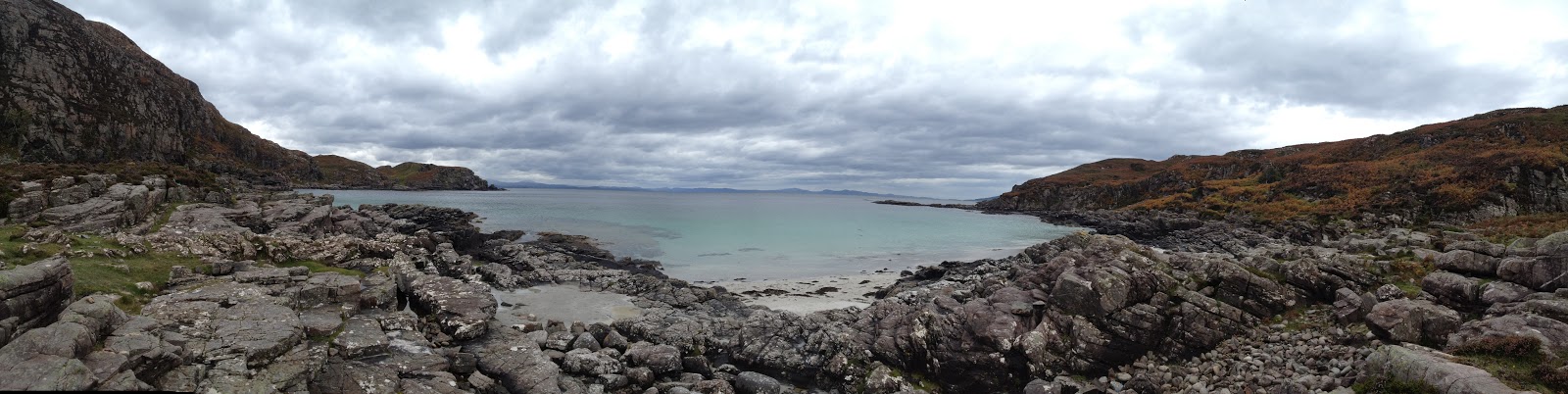
Scotland is the most beautiful place on Earth
 

The 47th Annual Mt. Baldy Run to the Top, September 3, 2012


      Mt. Baldy has long been one of my favorite races.  The seven mile course starts at the parking lot for Mt. San Antonio Ski Lift, elevation about 6,000 feet, and finishes at the very top of the mountain, at 10,064 feet above sea level.  The course plays right into my strengths.  With the exception of the first half mile, it is all uphill, but the trial is not overly technical.  If I ever have to pick a course for a match race, this will be the course I choose.

The drive out to Mt. Baldy is often beautiful


 The Start Line: Number 552 is Robert Leonardo, a highly accomplished local runner about my age who almost always finishes ahead of me.  This is only the second time I bested him.  
      I had a good race at Mt. Baldy this year.  Usually, I start out rather slowly, and am in about 50th place or so at the first mile.  This year, I ran harder at the start and was in perhaps 10th place at mile one.  By mile 4, the Notch, I was in 5th, and by the end I was in 4th overall, third male.  That's my highest finish in about ten attempts at this course, although my time of 1:16:16 was about four minutes slower than last year.  It is also the first time I've been beaten by a woman on this course!  The first woman, Annie O’Donnell, finished third overall, just ahead of me.

Mile 6 or so


Saturday, September 1, 2012

Pikes Peak: A Tale of Two Great Races

The Pikes Peak Ascent is like no other race I have ever run.  It begins in Manitou Springs, Colorado, at an elevation of 6,300 feet, and climbs 13.3 miles, mostly along the Barr Trail, finishing at the top of Pikes Peak at an elevation of 14,050 feet above sea level.  The average grade is about 11%.

But cold statistics such as these cannot capture the essence of the race.  It is a beautiful course, with incredible views over Manitou Springs, Colorado Springs and the plains beyond, yet natural beauty it not what brought me back to Pikes Peak three times, nor is it what makes me want to come back again next year to run the full marathon.

I came to Pikes Peak for the challenge, and specifically for the challenge of the last three miles of the race.  At the 10.2 mile mark, the course passes through 11,950 feet elevation at an aid station called A-Frame.  The final three miles of the race is at 12,000 feet or higher.   Those last three miles are brutal, especially for anyone who, like me, lives and trains at sea level.  This year, it took me 2:00:36 to reach A-Frame, and another 58:16 to cover the final segment, a pace of just under 20 minutes a mile.  I ran almost the entire first ten miles, but those last three I was mostly walking, with some very slow jogging mixed in.  Even so, this was my best performance on those last three miles.

I finished in 2:58:53, nearly ten minutes faster than last year and three minutes faster than in 2002.  I placed 39th overall, and won the 50-54 age group.  More importantly, I was completely exhausted at the finish line, leaving nothing on the course.  At the end, I was showing the first signs of altitude sickness, and took ten minutes of oxygen before riding in the shuttle down the mountain.  No, I wasn't in any real danger nor pain, just completely exhausted by my encounter with Pikes Peak.  I had taken a chance, run as hard as I could, and gauged my conditioning perfectly.  But the final result also depended on a measure of  luck.  Racing requires that you approach that fine edge between running too easy and running too hard, and whether you go over that edge is a function of things that are sometimes impossible to measure.  That is what racing is all about -- running the hardest, smartest race you can run, and accepting the outcome, whatever that may be.


Watch Data from Pikes Peak Ascent 2012

Jack had a very different experience.  He took the same chance that I did, but this time the mountain won.  There is no objective reason that should have happened.  Jack is in the best shape of his life.  In the first seven months of 2012, he ran his lifetime bests at 10k, half marathon (1:23:07, beating his prior best in 2001), marathon (first time under three hours), 50k and 50 mile.  He was well-rested for the race, and he didn't go out too fast, nor make any other objective mistake.  For whatever reason, the altitude and the mountain just got the better of him that day.

Approaching the Summit: the Start Line is Beyond the Horizon
It took Jack 5:18 to make it to the top of Pikes Peak.  He sat down for a moment to catch his breath before starting the descent, looking utterly exhausted, and I asked him how he was feeling.  He shot back, "I'm fine," with a spark in his eyes, clearly not interested in discussing the matter further.  He probably thought I was thinking of suggesting that he drop out, which was exactly what I was thinking.  But he had no intention whatsoever of dropping out, and was not interested in hearing any negative thoughts from me.

Jack finished the race in just over nine hours, a respectable time for some, but terrible for him.  Nevertheless, he took the opportunity presented by his slower pace to chat with and encourage fellow runners, and to thank the volunteers.    Somehow, he managed to run the final half mile or so, and to finish the race with a big smile on his face.  Not to say he looked good; it was easy to see how badly he had lost his battle with Pikes Peak.

He spent half an hour recovering in the tent before walking back to the car, and spent the balance of the day in the hotel room.  By eight or nine in the evening he was pretty much fully recovered and talking about next year's race.  No harm done.

It is so easy to be gracious when things go your way.  It is easy to finish strong when things go your way.  But, if you race correctly, by definition, things will not always go your way.  The true measure of a runner -- of a racer and of a man -- is how you respond when you do everything right and things still do not go your way.  I ran a great race at Pikes Peak; so did Jack.  The difference is that he had the opportunity to show the kind of runner and the kind of man that he is.  I hope that I perform half as well when I am confronted with that situation.